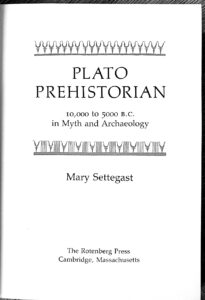
The work of American archaeologist Mary Settegast (1934-2020) shows how many of the contradictions and controversies that arise from archaeological findings become harmonized as soon as the findings are placed within the historical account offered by Greek thinkers like Plato – an account radically different from any other existing historical framework and which many scholars have long considered unsuitable as a reliable factual source for modern research.
In her book Plato, Prehistorian: 10,000 to 5,000 B.C. in Myth and Archaeology (1986) Settegast writes that since the 1960s a new historical framework is trying to come to fruition, a process that is still ongoing today. She writes:
“Archaeologists are aware of the inadequacy of the existing framework of thought. For almost two decades prehistorians have been seeking a new paradigm, a wholly new way of looking at the early world that would accomodate the growing number of contradictions to the present point of view.”(4)
Among the many contradictions there is the “Net of Heaven”, as it was called in the Tao Te Ching(1), that is the subject of a painted panel uncovered at the archaeological site Çatal Hüyük, depicting twelve hands above and seven hands below, representing the zodiac and the planets, and a net woven in between them. The panel reflects one of the many archaeological glitches and inconvenient truths that Settegast discusses in her book. She writes:
“If a similar design appeared in first millenium Mesopotamia, there would be no question of its zodiacal connotations. We are in now in the sixth millenium, however, and the possibility that a Time god with zodiacal attributes was already worshipped at the Neolithic site of Çatal Hüyük is thoroughly at odds with the conventional framework of thought.”(2)
As a conscientious scholar, Settegast lets the facts speak for themselves. Despite the scientific jargon, her lively spirit for truthseeking shines through on every page of her book and she cites hundreds of valuable sources. Writing at age 52, she reflects on some of the dubious situations in her field, such as the “practice of excavating no more than five percent of a site (and usually far less)”; the limitations and the downsides of carbon dating; the manners in which mythology has been misvalued; the vehement resistance against admitting that a longheld framework has become outdated, and, most of all, the dominant yet erroneous framework itself, to which Settegast dedicated the very first sentence of her book: “The more we learn about early man, the more difficult it is to describe him as primitive.”(3)
This scholarly struggle to replace the old with the new partially fuels the many popular yet undisciplined researchers today – those who either abandon the scientific method or those who are unwilling to adopt it; those who are in a rush to reach big audiences and wildly speculate on topics from the Old World like Atlantis. The selfish quest for proving a new historiography was condemned by Settegast as absolutely as the selfish quest for clinging to the collapsed historiography:
“The so-called Atlantis controversy already ranks as one of the most unproductive arguments of our time, largely based even now on belief and disbelief, both of which have led to some unforgiveable overstatements of what is a minimum of scientific fact.”(4)
What exactly is the responsibility of the historian, the prehistorian and the archaeologist? Without an intelligible past we can not have a stable present, Settegast writes:
“The reconstruction of the past is not, however, the primary concern of the New Archaeology. Born amid the cultural upheavals that followed two world wars, it has addressed itself to what are perceived as more critical and immediate needs of the times, namely, an understanding of the dynamics of cultural change. Its theoretical focus is on culture process rather than cultural history, on the discovery of universally applicable laws of change, valid for all periods, that would explain and thus help us to respond intelligently to the contemporary flux.”(5)
Plato, mythology, ancient texts from the East and West, the scriptures, initiation mysteries as well as Settegast’s archaeological findings, have in common that they all refer to the evolutionary process of overcoming man’s lower nature through free will; to developing man’s higher nature through a robust and self-conscious soul, and to the necessity of aligning the physical world with the unseen world in order to bring Earthly chaos into harmony.
Plato described in the Timaeus how man is to “see the revolutions of intelligence in the heavens and use their untroubled course to guide the troubled revolutions in our own understanding, which are akin to them; and so, by learning what they are and how to calculate them accurately according to their nature, correct the disorder of our own revolutions by the standard of the invariability of those of God.”(6)
The universal wisdom on how to fight the battles of human life, as well as the wisdom on how to restore a long lost harmony, is revived through Settegast’s scientific study of our physical past.
(1) Wilhelm, Richard. LaoTse und der Taoismus. Stuttgart, 1925. The “Net of Heaven” (the network of planets and constellations) which is “wide-meshed but lets nothing through” (LXXII. 179).
(2) Settegast, Mary. Plato, Prehistorian: 10,000 to 5000 B.C. in Myth and Archaeology. Cambridge, MA, Rotenberg Press, 1986. pp. 205. “[The Net of Heaven] was as impenetrable for the uninitiated as the veil of the goddess.” (Settegast, pp. 205).
(3) Ibid. pp. 1.
(4) Ibid. pp. 73.
(5) Ibid. pp. 7.
(6) Plato. Timaeus. Translated by Desmond Lee. Penguin Classics, 1971. pp. 47.
Written by Laura M. Slot, historian and writer with a focus on outsiders in twentieth century intellectual history. Her forthcoming book Postmaterialist Historiography will be published Fall 2026. lauraslot.com

Citations and translations are encouraged if accompanied by a reference to this blog article.
Post image photography by Laura M. Slot 2024.